
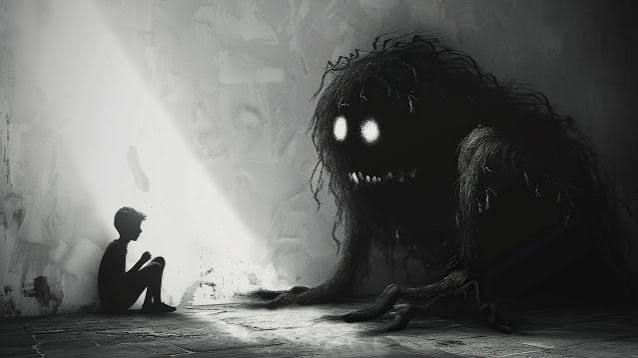
I want to tell you the uncomfortable truth about how I write villains: the good ones don’t come from imagination. They come from excavation.
Every antagonist I have ever written that a reader told me felt real, felt dangerous in a way that lingered, started the same way. Not with a plot need. Not with a character sheet. With a question I asked myself, alone, usually somewhere I couldn’t be interrupted: what is the version of me I don’t let anyone see?
That question has a name in psychology. Carl Jung called it the shadow self, the parts of our own personality we’ve disowned, buried, or refused to acknowledge because they didn’t fit the person we needed to be to survive, to be loved, to be accepted. And once you understand what the shadow actually is, you cannot write a genuinely complex villain, or a genuinely honest anti-hero, without going and looking at yours.
What Shadow Work Actually Is (And Isn’t)
Let me clear something up first, because the phrase “shadow work” gets thrown around a lot online and most of it is not what I’m talking about.
Shadow work is not about deciding you’re secretly a bad person. It’s not self-flagellation dressed up in therapy language. It is the practice of honestly acknowledging the parts of yourself you’ve pushed out of view because they were inconvenient, dangerous, or unacceptable somewhere along the way. Anger you were taught not to show. Selfishness you were taught to be ashamed of. The capacity, under the wrong conditions, to do harm. The wanting of things you were told good people don’t want.
None of that means you’re secretly a monster. It means you’re a full human being, and full human beings contain multitudes, including ones they’d rather not examine too closely.
For me, some of that shadow material is tied directly to my service. There is a version of me that existed under conditions most people will never have to operate inside. A version capable of hard, cold, necessary things. That version doesn’t disappear when you come home. She goes quiet. She waits. And if you don’t acknowledge her honestly, she doesn’t leave, she just finds sideways ways to surface, usually at the worst possible moment.
Writing gave that version of myself somewhere to go that wasn’t sideways. It gave her a page.
Every Villain I’ve Ever Written Well Started With a Question About Myself
Here is the practice, stripped down to what actually happens at my desk. Before I write a villain, I do not start with what they want in the plot. I start with a private, sometimes uncomfortable question: under what conditions could I become this person?
Not would I. Could I. Given a different set of losses, a different set of betrayals, a different set of circumstances stacked one on top of another the way circumstances actually stack in real life, is there a version of me that arrives at the same choices this character makes?
The answer is almost always yes. And that is not a disturbing discovery. That is the discovery that makes the villain work.
A villain who is simply evil, who commits harm because harm is what villains do, is not a character. He’s a plot device wearing a character’s clothes. A villain who commits harm because he can trace, step by step, a logic that made sense to him at the time, a logic built from real pain, real fear, real unmet need that curdled into something destructive, that villain is a mirror. And mirrors are what make readers feel something they can’t shake.
The Anti-Hero Problem: Writing Someone Who Is Both Right and Wrong
The anti-hero is harder than the villain, honestly, because the anti-hero has to be sympathetic and dangerous at the same time, and readers can smell it immediately if you fake either half.
This is where shadow work becomes not just useful but necessary. Because writing an anti-hero convincingly means writing someone who is, at various points, genuinely right and genuinely wrong, sometimes in the same scene, sometimes about the same thing. That kind of moral instability is very hard to write from the outside. It is much easier to write from the inside, from a place where you have actually sat with your own capacity to be both. Where you’ve had to admit that you have made choices you still can’t fully defend, for reasons that felt airtight at the time and look different now.
I don’t write my anti-heroes as good people wearing a dangerous costume. I write them as people who did what they believed they had to do, who paid a real price for it, and who are not entirely sure, even now, whether they’d choose differently. That uncertainty is the shadow. That is what I’m actually drawing from when I write it.
Questions I Ask Before I Write a Villain or Anti-Hero
I keep a private page of prompts I return to, and I’ll share the ones I use most, because I think they’re useful whether you write dark fiction or not.
What did I do, once, that I still haven’t told anyone the full truth about? Not a confession for the page, just a private honest accounting for yourself. That is shadow material.
What do I envy, and what does that envy say I actually want? Envy is one of the most underused emotional resources in fiction. It tells you exactly what a character, or a writer, believes they’ve been denied.
Where have I justified something to myself that I would judge harshly in someone else? That gap, between the standard we hold others to and the standard we quietly grant ourselves, is where an enormous amount of villain logic lives.
What would I be capable of if the people I love were threatened and there were no rules left? This one is uncomfortable and it should be. It is also where some of the most honest anti-hero material I’ve ever written came from.
I don’t answer these questions for an audience. I answer them for myself, privately, and then I let the character carry what I found. That is the entire method.
What Shadow Work Gave Me That Craft Books Didn’t
I have read the craft books. I have studied villain motivation and antagonist arcs and the mechanics of a compelling foil. All of it is useful. None of it gets you to the thing that actually makes a reader stop and feel unsettled in a way they can’t explain, which is recognition.
Readers don’t fear villains because villains are powerful. They fear villains, the good ones, because some part of the villain’s logic makes a terrible kind of sense. Because somewhere in the reading experience, a reader has a flicker of understanding they didn’t ask for and can’t fully dismiss. That flicker only happens when the writer has done the work of finding it in themselves first. You cannot manufacture recognition from the outside. You have to have actually felt the thing you’re describing, even if you never acted on it, even if you spent years making sure you never would.
Shadow work is not comfortable. I won’t pretend it is. Sitting down and honestly asking yourself what you’re capable of under the wrong conditions is not a fun Tuesday afternoon exercise. But it is, in my experience, the single most reliable source of authentic darkness a writer has access to. Not research. Not imagination stretched thin. The shadow, acknowledged, examined, and finally, carefully, given somewhere useful to go.
Violet Falcone has a shadow. Every worthwhile character I’ve written has one, hero and villain alike, because that’s the only kind of character that reads as fully human. I found hers by going and finding mine first. That is the whole secret, and it was never really a secret. It was just something most of us would rather not look at directly.
Go look. Your villains will thank you. So, eventually, will you.
— Leigh Nightshade
If this post resonated with you, share it. You never know who needs to read it today.